
The world of art is changing fast. Creativity is now being shaped by machines and algorithms. This big change is altering how we see and make art.
These advanced systems look at lots of images and styles to create new art. They are making us rethink what creativity really is. The machine is becoming more than just a tool; it’s a active collaborator in making art.
What started as a new tech idea is now a big deal. Generative AI is changing how artists and designers work. It gives them new ways to think and make art on a digital canvas.
This article will look into the key parts of this change. We’ll explore the technological innovation behind it, the philosophical debates on authorship, and the market evolution. The journey of AI-generated art is just starting, and its effects are already clear.
The Rise of the Machine Artist: From Novelty to Mainstream
In October 2018, Christie’s auctioned Portrait of Edmond de Belamy for over $400,000. This was a big moment for AI art. The Paris-based collective Obvious used a Generative Adversarial Network (GAN) to create it.
This event did more than just sell a painting. It made the art world think about a new kind of creator. This creator was digital, not human.
This change was big. Machine learning art was no longer just for academics. It had become a global phenomenon, changing how we see creativity and authorship.
Two things helped AI art grow fast. First, better computers made it easier to train complex neural networks. Second, new algorithms like GANs and diffusion models let artists create beautiful images.
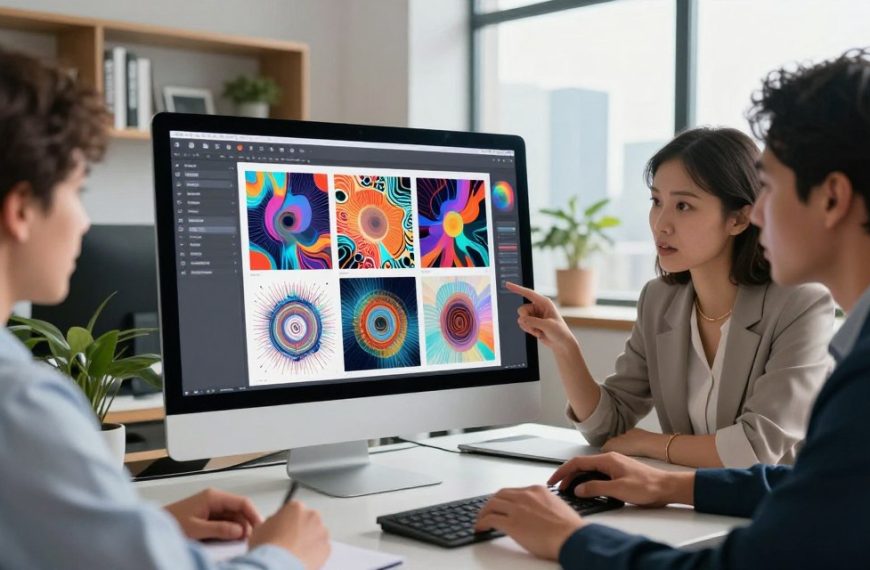
These changes made art creation more accessible. Now, illustrators, designers, and hobbyists could use AI to make art. Platforms made it easy to use AI with simple text prompts. Artists started to see themselves as curators and editors of AI’s creations.
The path from unknown to mainstream is marked by key moments. The table below shows how AI became a big part of art.
| Year | Milestone | Impact on Mainstream Adoption |
|---|---|---|
| 2014 | Introduction of Generative Adversarial Networks (GANs) | Provided the foundational architecture for generating realistic, novel images. |
| 2018 | Christie’s auction of “Portrait of Edmond de Belamy” | Legitimised AI art in the fine art market, generating global media attention. |
| 2021 | Release of DALL-E by OpenAI | Democratised text-to-image generation, showing its wide appeal. |
| 2022 | Open-source release of Stable Diffusion | Enabled local, accessible creation, growing a big community. |
| 2023 | Integration into mainstream creative software (e.g., Adobe Firefly) | Signalled industry-wide adoption, making AI tools common in work. |
This journey shows a clear pattern. Each step made it easier for more people to use AI in art. What was once new is now a key part of digital creativity. The machine artist has become a valued partner, changing how art is made.
Deconstructing the Process: How AI Art Generation Actually Works
The magic of AI art generation is not magic at all. It’s a complex process built on three key technologies. From a user’s text prompt to a finished image, it involves advanced algorithms. These algorithms have evolved a lot.
At its heart, this text-to-image AI uses neural networks trained on billions of image-text pairs. They learn to spot patterns and create new visuals.
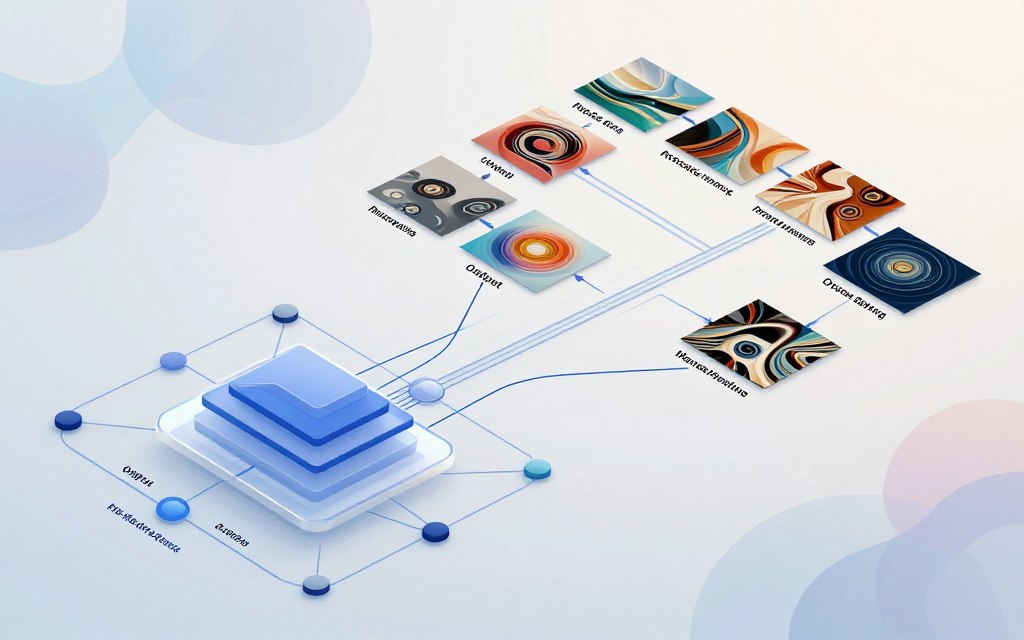
The user experience is simple. Just type a description, and you get a picture. But the backend mechanics are fascinating. Two main architectures, Generative Adversarial Networks and Diffusion Models, create the images. A third technology, CLIP, links language and vision.
Generative Adversarial Networks (GANs): The Artistic Duel
Generative Adversarial Networks, or GANs, were a big breakthrough in AI image synthesis. It’s like an art forger versus an art critic.
The Generator creates images from random noise. It aims to make fakes that look real. The Discriminator, trained on real images, tries to spot the forgery.
This duel continues until the generator makes very realistic images. As researcher Ian Goodfellow said, “The generator gets better at fooling the discriminator, and the discriminator gets better at catching fakes.” This was key for creating early AI faces and art.
Diffusion Models: The Power of De-noising
Diffusion Models are now used in platforms like DALL-E 2 and Stable Diffusion. It’s like a sculptor revealing a form from a block of marble.
It works in two phases. First, a clear image is corrupted by adding digital noise until it’s static. The AI learns this noising process. Then, it undoes the noise step by step to create a new image.
To make a new image, the system starts with random noise. It “de-noises” this chaos, step by step, guided by the text prompt. This method is celebrated for its stability and high-quality, diverse outputs.
| Feature | Generative Adversarial Networks (GANs) | Diffusion Models |
|---|---|---|
| Core Architecture | Two competing networks: Generator & Discriminator. | A single network trained to de-noise images. |
| Primary Process | Adversarial training through critique and improvement. | Iterative de-noising from random noise to clear image. |
| Key Strength | Can produce extremely sharp, realistic outputs quickly. | Excels at diversity, detail, and following complex prompts. |
| Common Challenge | Training can be unstable; may lack output variety. | Computationally intensive; slower generation times. |
| Typical Use | Early photorealistic faces, style transfer. | Modern text-to-image systems like DALL-E 2, Stable Diffusion. |
CLIP and Multimodal Understanding: From Text to Image
CLIP is the bridge between words and pixels. It’s a neural network trained on images and captions. It learns to represent both text and visuals numerically.
When you type “a cyberpunk cat wearing a neon jacket,” CLIP helps the image generator visualise the semantic meaning of those words.
“CLIP’s breakthrough was learning a visual representation from natural language supervision. It connects descriptions to imagery in a way that is remarkably aligned with human perception.”
This multimodal understanding makes modern text-to-image AI very responsive and accurate. It allows the generator to be guided by the nuanced concepts in the prompt. This ensures the output matches the user’s intent.
Together, these technologies power today’s AI art creation. The generator builds the image, and the multimodal model ensures it matches our words. This redefines how we interact with creative tools.
The Toolbox: Major Platforms Powering the Revolution
A few key platforms are at the heart of today’s AI art movement. These AI art platforms turn our ideas into digital pictures. Knowing what each platform can do is key for those wanting to use these creative AI tools.
OpenAI’s DALL-E and DALL-E 2: Pioneering Text-to-Image
OpenAI’s DALL-E in 2021 was a big step for art made by machines. DALL-E 2 then took it even further, making images more detailed and clear. It’s a leader in making pictures from text, showing how well machines can understand what we mean.
Users can ask for things like “an armchair in the shape of an avocado” or “a photorealistic teddy bear swimming in the Venetian canals.” DALL-E 2’s use of the CLIP model helps it grasp the meaning behind words. This makes it great for both creative and business projects.
Midjourney: The Aesthetic Sensibility
Midjourney stands out by focusing on beauty and style. It’s mainly used through Discord, creating a special community. Its images are often dreamy, painterly, and full of life.
Midjourney’s algorithms aim for beauty and style. Its pictures have deep colours, textures, and lighting. It’s perfect for those wanting to capture a certain mood or style, like fantasy or cyberpunk.
Stable Diffusion: Open-Source Accessibility
Stable Diffusion by Stability AI made AI art more accessible. By being open-source, it opened up new possibilities for innovation. Now, people can use it on their own devices and make changes as they like.
This openness has led to many new tools and applications. From web sites to Photoshop plugins, Stable Diffusion’s design is everywhere. It also raises important questions about who controls these tools, but it’s changed the game for AI art platforms.
Other Notable Tools: Craiyon, DreamStudio, and Adobe Firefly
There are many more tools beyond the big names. Craiyon, for example, is free and easy to use for beginners. It’s not as detailed, but it’s a great starting point.
DreamStudio is Stability AI’s paid version, with more features. Adobe Firefly, part of Creative Cloud, is big news for professionals. It’s designed for safe, commercial use, appealing to designers.
Each tool offers a unique way to explore machine creativity. The choice depends on what you value most: amazing detail, artistic flair, or the freedom to customize.
The Human-AI Collaboration: New Models of Creative Practice
AI art has brought about a new way of making art. It’s all about working together, improving, and having a unique conversation. This change moves away from the idea of the machine alone creating art. Instead, it’s about humans and machines working together to make something new.
The Artist as Curator and Editor
The role of the artist has changed with AI art. Now, they act as directors, curators, and editors. People like Mario Klingemann and Refik Anadol show how this works. They don’t just press a button to create art. They guide the AI, work with big datasets, and fine-tune the results.
For these artists, AI is like a dynamic material. They set the rules, pick the best versions, and refine the art. This includes:
- Strategic Direction: Setting the goals and style for the AI.
- Iterative Selection: Choosing the best results from many options.
- Creative Post-Processing: Using digital tools to enhance the AI’s work.
This approach boosts human creativity. It lets artists explore new areas quickly and on a large scale. It makes choosing the right possibilities a key part of their job.
Prompt Engineering: The New Artistic Language
Prompt engineering is the other half of this new art form. It’s about writing detailed instructions for the AI. It’s become a key skill for AI artists.
A good prompt leads to better results. Artists learn to use a special language to guide the AI. They mix subject matter with style, composition, lighting, and emotions.
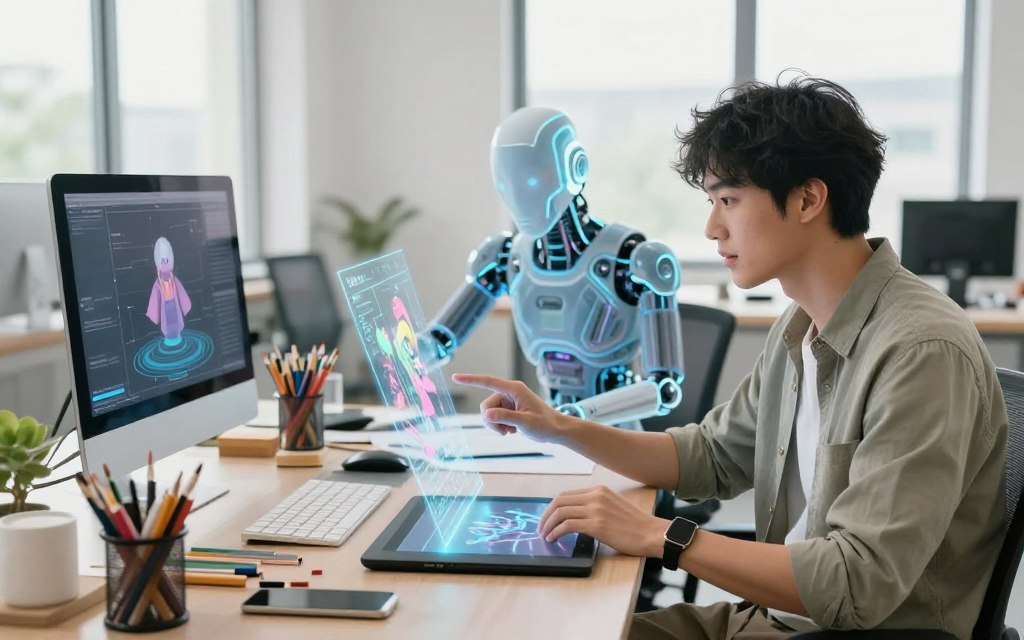
The best art comes from a back-and-forth conversation. The artist gives a prompt, sees the AI’s response, and then improves their instructions. This cycle is where the magic happens. It turns making art into a dialogue between human ideas and machine skills.
Getting good at this language lets artists control the AI art process. It turns the AI from a mystery into a helpful partner. The prompt is more than a command; it’s a way to spark creativity in both humans and machines.
Challenging the Canon: AI’s Impact on Art History and Aesthetics
AI-generated art is changing how we see art history and judge beauty. It doesn’t just add a new tool for artists. It questions the basics of art creation, value, and understanding.
These systems learn from huge datasets of images from all over history and cultures. Generative AI gets a unique view of art history. It can mix styles from different eras and places.
This challenges the old story of art history. The idea of art evolving from realism to modernism is shaken. AI sees all styles as equal, not in a timeline.
This sparks a big debate. Can a machine be truly creative? Or is it just copying? Some say AI lacks the soul of human art. Others see it as a new kind of creativity.
Who owns the art when AI makes it from a prompt? Is it the programmer, the user, the artists in the data, or the AI itself? This question shakes our view of art and genius.
New art styles are born from this confusion. We see post-digital collage and algorithmic surrealism. These styles challenge our old ways of seeing beauty and skill.
In the end, AI-generated art makes us think about what we value in art. It’s not about erasing the past. It’s about mixing and questioning, leading to a broader view of art today.
The Legal Canvas: Copyright, Ownership, and Ethical Quandaries
The rise of AI-generated images has outpaced legal and ethical systems. This creates a complex landscape where innovation meets established principles. Three key issues are at the forefront: using copyrighted material, ambiguous ownership, and addressing biases.
Training Data and the Fair Use Debate
Machine learning art relies on vast datasets, often taken without permission. Billions of copyrighted images fuel these systems. Developers argue this is fair use, for research or education.
Many artists and institutions disagree. They see it as commercial exploitation. High-profile lawsuits, like Getty Images against Stability AI, challenge this practice.
“Using copyrighted works to train commercial AI systems without licence or compensation threatens the very ecosystem that feeds creativity.”
New models are being proposed. These include opt-in systems and royalty schemes. Clear labelling of AI-generated art is also seen as essential.
Who Owns the Output? A Legal Grey Area
If you create an image on a platform, who owns it? The answer is unclear. Current U.S. law requires human authorship for copyright.
This leaves ownership to platform terms. The question remains: could an output be considered a derivative work of the training data? This legal grey area creates uncertainty for commercial use.
| Issue | Key Question | Current Legal Status | Primary Stakeholders Impacted |
|---|---|---|---|
| Copyright of Output | Is a work created by AI eligible for copyright? | Generally no without significant human input; guided by platform Terms of Service. | Individual users, commercial clients. |
| Training Data Licence | Does scraping the web for training images constitute fair use? | Under intense legal dispute; multiple lawsuits pending. | Artists, photographers, stock image companies, AI developers. |
| Derivative Work Claims | Can an AI output infringe the copyright of art in its training set? | Untested in higher courts; a major unresolved risk. | All original content creators, AI users. |
| Ethical Attribution | Do artists whose work trained a model deserve credit or compensation? | No legal requirement exists; considered an ethical imperative. | Artists, the broader creative community. |
Bias, Representation, and Ethical Responsibility
The problem of bias is a critical flaw in AI systems. If a machine learning art model is trained on biased datasets, its outputs will reflect those biases. This can lead to harmful stereotypes.
Common issues include:
- Gender bias in professional roles (e.g., generating “CEO” as predominantly male).
- Racial bias in beauty standards or historical depictions.
- Cultural stereotyping in responses to prompts about specific countries or traditions.
Addressing bias is a shared responsibility. Developers must use diverse and representative datasets. Users can help by using prompt engineering to counteract stereotypes. The goal is to ensure AI creativity does not amplify existing prejudices.
The challenges of copyright, ownership, and bias are not just technicalities. They are fundamental questions for AI-generated art. Solving them requires collaboration between technologists, artists, legal experts, and ethicists.
Market Realities: The Economics of AI-Generated Art
AI art generation is changing the game in many industries. It’s not just a trend but a big economic shift. This change affects everything from auction houses to advertising agencies.
This new market has two main parts. One is the rare and valuable world of fine art collecting. The other is the fast and busy world of commercial design.
AI Art in the Commercial and Fine Art Markets
The fine art market was the first to see AI’s value. In 2018, Christie’s sold Edmond de Belamy for $432,500. This sale made the art world think about AI’s role in creating art.
But, not all AI art sales are as big. The fine art market is now dealing with issues like how to value AI art. With AI, artists can make many versions of a piece. So, what makes one piece special?
Value now comes from the artist’s vision, the story behind the art, or if it’s a new series.
The commercial world is different. It values speed and efficiency over uniqueness. Creative AI tools are changing how we work in marketing, e-commerce, and media.
- Marketing & Advertising: Making lots of ad variations and social media images quickly.
- E-commerce: Creating product images and even photoshoots without traditional shoots.
- Media & Entertainment: Making concept art and background assets for games and films.
This use of AI is making creativity more accessible. Small teams can now do big campaigns that used to need lots of money and time.
Disruption and Adaptation in Creative Industries
AI’s efficiency is making some worry about job losses in design and photography. If AI can do a good job, does the human’s role matter less?
The biggest change might not be losing jobs, but seeing some creative tasks lose value.
But, there’s a different view. Professionals are using AI as a tool, not a replacement. AI does the basic work, and humans focus on the creative and emotional parts.
The market is splitting. There’s the fast, cheap AI content and the premium, human-AI collaborations. Success now means knowing how to work with AI and keep the human touch.
Future Horizons: Where is AI Art Generation Heading Next?
The future of generative AI is exciting. It will move from creating single images to telling stories in new ways. This technology will become a key partner in ongoing creative projects.
One big change is real-time collaboration. Imagine making digital art with gestures and AI suggesting changes instantly. This will make creating art more natural and ongoing.
The text-to-image AI model is great for one-off images. But it will soon keep a story consistent. Artists will guide AI to create consistent scenes for animations and movies.
Generative AI will also create immersive worlds for virtual reality. It will make art that changes with the viewer’s mood in augmented reality. Art will start to fill our spaces.
The biggest change might be in the tools artists use. AI will become a core part of all creative software.
Future AI models will understand more than just words. They will grasp emotions and abstract ideas. This will lead to a deeper connection between humans and machines.
These changes will bring many new things to art:
- From Static to Dynamic: AI will create videos and 3D files, not just images.
- The Rise of the AI Cinematographer: AI will help make videos with controlled camera work.
- Personalised Immersive Experiences: Museums will use AI to create unique experiences for visitors.
- Democratisation of Complex Forms: AI will make complex art like 3D modelling easy to do with words.
The future is about combining human and machine creativity. Artists will guide AI, while AI does the hard work. This partnership will open up new forms of creativity we can’t yet imagine.
Conclusion
AI art generation has changed the creative world. It opens new possibilities, working alongside artists, not replacing them.
This technology helps create ideas fast and makes art more accessible. But, it raises big questions about originality, ethics, and the environment. A detailed look at the pros and cons of AI shows the challenges it brings.
At its heart, AI art can’t match the vision and feeling that a human artist brings. Humans create the idea, and AI helps bring it to life.
The world of AI art is always changing. The future will depend on how technology and human creativity work together.
FAQ
What is the core difference between how GANs and diffusion models create AI art?
Generative Adversarial Networks (GANs) have two neural networks. One creates images, and the other critiques them. This makes the images more realistic. On the other hand, diffusion models like Stable Diffusion start with random data and shape it into images based on text prompts. They are known for their high-quality results.
Do I need to be an artist or a programmer to use AI art generators?
No, you don’t need to be an artist or programmer. Tools like Craiyon and Midjourney are easy to use. You just need to know how to write good prompts. While knowing art helps, anyone can start making images. For more control, like with Stable Diffusion, some tech knowledge is useful.
Who legally owns an image created by an AI art platform?
Who owns an AI image is a big legal question. Each platform has its own rules. Usually, the person who made the image gets a licence to use it. But, they don’t always own it fully. This is because copyright law needs a human creator.
It gets even more complicated when AI uses copyrighted images to learn. It’s important to check the rules of each tool, like DALL-E or Stable Diffusion.
Is AI art generation considered “real” art, and can it be creative?
AI art raises big questions about creativity. The machine uses patterns from its training data. But, the human user adds the creative spark. Many see AI art as a team effort, where the human directs and the AI executes.
Its status as “real” art is shown by its inclusion in galleries and auctions. For example, “Portrait of Edmond de Belamy” sold at Christie’s.
How are commercial artists and designers using AI tools like Adobe Firefly?
Professionals are using AI to make their work faster and more creative. They use it for ideas, mood boards, and unique images. Adobe Firefly lets them edit and mix AI images easily.
This changes their role to editing and curating, not just creating. It makes their work better, not worse.
What are the ethical concerns regarding bias in AI-generated art?
AI art can show biases from its training data. This can lead to stereotypes about gender, race, and culture. For example, “a CEO” might always be an older man.
Developers and users must be aware of this. They should use inclusive prompts and work on better training data. This helps avoid harmful biases.
What does the future hold for AI art generation technology?
The future of AI art is exciting and changing fast. We’ll see more consistent characters for stories and AI videos. There will also be tools for real-time collaboration and new art forms in VR/AR.
The tech will also understand stories, emotions, and abstract ideas better. It’s a thrilling time for AI art.

 By
By

 By
By