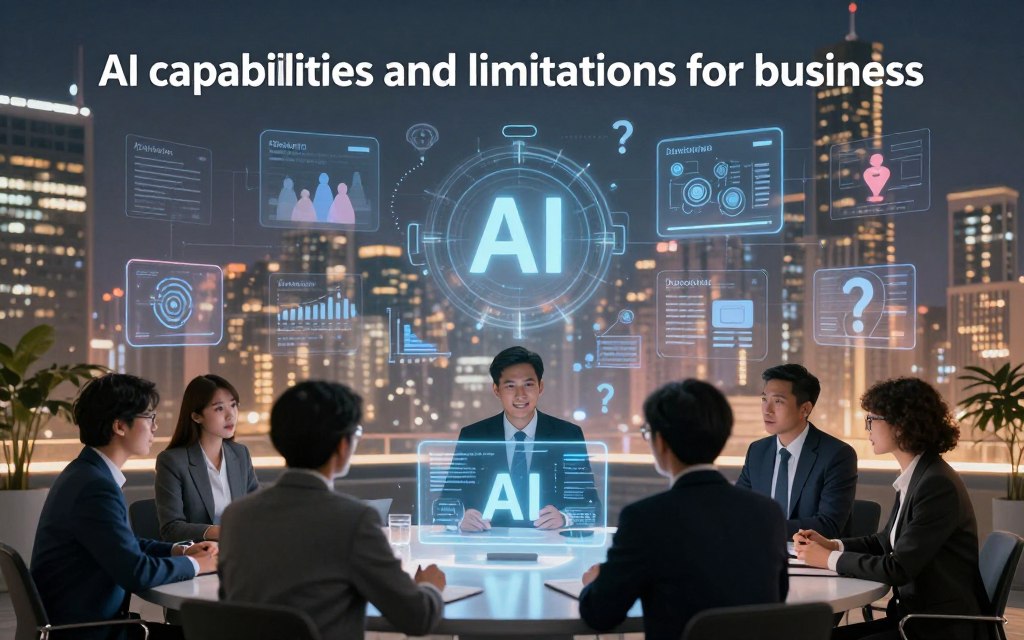

The talk about artificial intelligence is filled with both excitement and worry. Some say it will change everything, while others fear it could be dangerous. For business leaders, this makes it hard to know what’s real and what’s just talk.
Experts like Andrew Ng say AI is changing industries but it’s not a miracle. It’s important to see things clearly. Not understanding AI’s true AI capabilities can lead to big mistakes and lost money.
This article aims to be a clear guide. We’ll look at what AI can do well and what it can’t. Our goal is to help you make smart choices about using AI in your business.
That broader commercial context becomes clearer when you look at business database systems and how teams apply AI in day-to-day operations.
The Current State of AI in Business
AI has come a long way from being a simple tool to now being able to talk like humans. Just ten years ago, AI was mainly used for specific tasks. Now, it’s everywhere, making our daily lives and work easier.
AI has moved from being on the sidelines to being at the heart of things. Back then, AI adoption was hard and expensive. It was mostly for big tech companies and research places. These early AI systems could only do one thing well and couldn’t learn much.
Now, AI is everywhere. It helps Netflix suggest movies, sorts your social media, and makes Google Search better. It’s also in Tesla’s Autopilot and your bank’s fraud detection. This shows AI has become a key part of our lives.
Thanks to generative AI and large language models, AI is more accessible. Small businesses can now use the same advanced AI as big ones. This has made innovation more open to everyone, making things more competitive.
The table below shows how AI in business has changed over the last decade:
| Aspect | Circa 2014 | 2024 |
|---|---|---|
| Primary Focus | Narrow, rules-based automation and predictive analytics. | Generative creation, complex reasoning, and adaptive learning. |
| Typical Applications | Spam filters, basic chatbots, isolated data analysis. | Hyper-personalised marketing, autonomous systems, creative content co-creation, real-time supply chain optimisation. |
| Accessibility | High barrier to entry; required specialised data science teams. | Low-code tools and API-driven services enable widespread integration. |
| Key Technology | Traditional machine learning (e.g., random forests, SVMs). | Generative AI and large language models (e.g., GPT-4, Claude). |
Today, AI can understand and create human-like content. Generative AI can write, design, and solve problems. It works with us, not just for us. This is thanks to large language models that learn from huge amounts of data.
But, this new AI power brings new challenges. It raises questions about ethics, bias, and who’s in control. Knowing both the benefits and limits of AI is key for business leaders. It helps them use AI wisely in their organisations.
What AI Can and Can’t Do Yet for Your Business
The promise of AI for business transformation is huge. Yet, a closer look shows it has both strengths and weaknesses. Knowing this difference is key to using AI well.
AI does best in places with clear rules and lots of clean data. It shines in three main areas. It automates tasks that need to be done over and over. It also digs deep into data to find patterns we can’t see. Plus, it makes customer interactions super personal, but only on a big scale.
AI is great for tasks that follow rules, data analysis, and making things personal for lots of people. But it can’t handle unclear situations, make big decisions alone, or deal with bad data.
But AI has big challenges outside these areas. It struggles with things that are unclear, complex, or new. It can’t make decisions on its own when ethics, empathy, or long-term plans are involved. Also, its results are only as good as the data it gets.
The table below shows clearly what AI can do and what it can’t. It helps us understand the limits of AI:
| AI Can (Proficiencies) | AI Can’t Yet (Limitations) | Key Insight for Business |
|---|---|---|
| Execute predefined, repetitive processes | Navigate unstructured problems with ambiguity | Ideal for back-office automation, not for open-ended innovation. |
| Analyse structured data to find correlations | Understand context or apply common sense | Provides powerful diagnostics, but human interpretation is essential for meaning. |
| Deliver personalised content based on user data | Build genuine emotional rapport or trust | Scales marketing touchpoints, but human agents are needed for complex relationships. |
| Optimise logistics and forecast demand | Make final, high-stakes ethical or strategic calls | Supports decision-making with data, but the accountability remains human. |
This difference is not a bad thing about AI. It’s a guide for using it right. Knowing where AI is good helps us use it where it adds real value. It also shows the importance of human skills like creativity and strategy. This sets the stage for looking into specific areas where AI can help.
Automating Repetitive Tasks and Processes
AI is great at taking over tasks that humans do over and over. It uses rules and patterns to make work easier. This helps make businesses more efficient.
AI is changing how businesses work. It helps with tasks like checking invoices and managing stock. This saves money and reduces mistakes.
Streamlining Administrative and Back-Office Work
AI can change finance, HR, and admin work. It can sort documents and extract data quickly. This is better than doing it by hand.
AI works all the time, so tasks like checking employee details are done right. This lets people focus on things that need a human touch.
Optimising Supply Chain and Inventory Management
AI also helps with complex tasks. It looks at sales data and weather to predict demand. This helps manage stock better.
With AI, businesses can keep the right amount of stock. This saves money and prevents running out of stock. AI also helps plan the best routes for deliveries, saving fuel and time.
Recognising the Boundaries of Automation
AI is very good at doing one thing well. But it can’t do many things at once like humans do. It’s great at following a set of rules but not at switching between tasks.
AI can’t handle complex, unstructured problems. It’s not as good at solving problems that need a human touch. It’s better at focusing on one thing at a time.
The table below shows what AI can and can’t do:
| Task Characteristic | AI Automation Proficiency | Human Worker Proficiency |
|---|---|---|
| Structured, Rules-Based Sequence | Excellent. Executes predefined steps flawlessly and at scale. | Good, but prone to fatigue and error in high-volume repetition. |
| Unstructured, Ambiguous Problem | Poor. Requires clear parameters and data inputs to function. | Excellent. Can use intuition, experience, and common sense to navigate. |
| Context-Switching Between Unrelated Tasks | Very Low. Designed for dedicated workflow streams. | High. Can adapt and re-prioritise dynamically based on new information. |
| Learning from a Single Example or Abstract Principle | Low. Typically requires vast datasets for training. | High. Can apply a lesson from one scenario to a conceptually similar but different one. |
To use AI well, find tasks that are clear and follow a pattern. Leave tasks that need human thinking to your team.
Analysing Data and Uncovering Insights
Artificial intelligence has changed how we do business intelligence. Teams used to spend weeks on spreadsheets. Now, AI can process huge datasets in seconds, spotting things we miss.
This turns raw data into a valuable asset. It helps businesses make better, faster decisions.
From Raw Data to Actionable Intelligence
Modern AI tools for data analysis find patterns in unstructured data. For example, Invoca’s Signal Discovery looks at phone calls to find customer concerns. Financial trading algorithms make quick decisions based on news and market data.
This is predictive analytics. AI learns from past data to predict future trends. It can forecast demand, spot customer churn, or predict machine failures.
But, the quality of AI depends on the data. Bad data leads to bad AI decisions. So, cleaning and preparing data is key for reliable insights.
Leveraging AI-Powered Business Intelligence Platforms
Companies are using business intelligence suites with AI. Tools like Microsoft Power BI and Tableau let users ask questions in simple English. They get answers in visual formats.
These platforms offer big benefits:
- Speed and Scale: They handle millions of data points across different areas.
- Anomaly Detection: AI flags unusual data, like sudden sales drops or traffic spikes.
- Automated Reporting: They create reports automatically, freeing up analysts for deeper analysis.
These tools make advanced predictive analytics accessible to everyone, not just experts.
The Crucial Role of Human Context and Interpretation
AI insights are powerful but not self-executing. An algorithm can predict what will happen but can’t explain why or what to do about it.
Human expertise is needed to interpret these insights. For example, an AI might suggest launching a product in a new market. But a seasoned executive must consider ethical and strategic factors.
AI can’t understand complex customer emotions or come up with creative ideas. The best teams use AI for data analysis and humans for strategy and creativity.
Transforming Customer Service and Engagement
AI is changing how we talk to customers. It moves from just answering questions to really connecting with people. This change uses two main things: chatbots and personalising data.
The goal is to make customer service better and more personal. This makes every interaction more meaningful.
The Rise of Sophisticated Chatbots and Virtual Agents
Chatbots and virtual agents are at the heart of AI in customer service. They handle lots of simple questions all day, every day. This lets real people focus on harder issues.
Today’s chatbots are smarter than before. They understand what you mean and can have long conversations. Some even know if you’re upset.
But, chatbots can’t really feel for you. They’re great at giving info but not at showing real feelings. So, it’s important to know when to bring in a human.
Hyper-Personalisation of Marketing and Sales Interactions
AI also changes how we market and sell. Hyper-personalisation uses AI to make things just for you. It looks at what you like and what you’ve done before.
This means ads and offers that really speak to you. It’s not just about using your name. It’s about making things that feel made just for you.
AI can look at lots of data fast. This lets it find patterns we can’t see. It makes marketing more effective and personal.
Scenarios Where Human Intervention Remains Essential
Even with all the tech, some things need a human touch. AI can’t understand emotions or solve problems in a creative way.
Humans are key in certain situations:
- Complex Complaints and Disputes: Humans are needed for tricky issues that involve lots of rules or big money.
- Sensitive and Emotional Issues: Humans are best for tough times like losing someone or dealing with health problems. They can offer real comfort.
- Strategic Relationship Building: Building strong relationships with important clients needs a personal touch. Humans can connect on a deeper level.
- Unstructured Problem-Solving: When a problem is new or complex, humans are better at finding solutions.
In these cases, AI helps by giving humans the right information. Humans then use their skills to solve the problem.
| Interaction Dimension | AI-Driven Service | Human-Led Service |
|---|---|---|
| Availability & Scale | 24/7 operation, instant response to thousands simultaneously. | Limited by working hours and agent capacity. |
| Personalisation Depth | Excellent at behavioural and transactional hyper-personalisation (product recommendations, targeted content). | Excels at emotional and contextual personalisation (remembering personal details, empathetic responses). |
| Emotional Intelligence | Can detect basic sentiment but cannot genuinely empathise or build rapport. | High capacity for empathy, compassion, and building trusting relationships. |
| Problem-Solving Type | Best for standardised, rule-based queries with clear solutions. | Essential for novel, complex, or ambiguous problems requiring creative judgement. |
| Cost Efficiency | High for routine, high-volume tasks, reducing operational costs. | Higher per-interaction cost but delivers superior value in critical scenarios. |
The best approach now is to use both AI and humans together. Chatbots handle simple tasks, while personalisation makes marketing feel special. Humans then step in for the tough stuff, where their skills really matter. This mix makes service better and keeps the human touch.
Assisting with Content and Marketing Creation
The marketing world is now using generative AI to change how we talk to customers. This new way of AI content creation and marketing automation is fast and creative. But, it’s important to know what it can and can’t do.
Drafting Copy, Generating Ideas, and Overcoming Writer’s Block
Generative AI is great for helping writers and marketers. It’s best at the start of making content. You can use it to:
- Generate many headline options or email subject lines quickly.
- Write first drafts of blog posts, social media captions, or product descriptions.
- Break through writer’s block by coming up with new ideas based on a brief.
AI works well because it looks at lots of texts and finds patterns. It can mix these patterns well. But, it can’t come up with new ideas from nothing. It’s good for starting ideas and drafts, but not for the final touches.
Producing Basic Visuals and Multimedia Content
AI can also help with visuals. It can make simple graphics, social media images, short videos, and animations. This is a big help for small teams or quick projects.
For example, you can make branded banner images for a new product or a short animated video from a script. This saves a lot of time and lets designers focus on more creative tasks.
The Challenge of Authenticity, Originality, and Coherent Brand Voice
But, there’s a big challenge with generative AI. It’s hard to make it sound unique and true to your brand. AI is trained on lots of internet data, which can make it sound generic.
An AI can write good copy, but it can’t really get your brand’s values or tone. Keeping your brand’s voice consistent needs a lot of human work. The AI’s output is good but lacks the real touch and feeling of human work.
Being original and strategic is what humans do best. Marketers now act as curators and editors. They guide the AI, refine its work, and add the real character that only humans can. This way, AI’s speed and scale help, but the content stays true to the brand.
Enhancing Predictive Maintenance and Operations
Predictive functions, powered by advanced AI, are changing how businesses operate. They move from reacting to problems to preventing them. This change reduces surprises and boosts efficiency in many areas.
AI looks at past and current data to predict future trends. This helps improve operational efficiency and makes businesses more resilient.
Accurately Forecasting Demand and Market Movements
AI is great at demand forecasting. It goes beyond simple guesses by looking at many factors. These include past sales, trends, and even social media and weather.
This leads to more accurate predictions of what customers will want and how markets will change. It helps with managing stock, planning production, and cash flow. In finance, AI helps with trading and risk management. It also guides self-driving cars to predict other drivers’ actions.
Preventing Downtime Through Predictive Asset Maintenance
In industries like manufacturing and energy, unexpected equipment failures cost a lot. Predictive maintenance, enhanced by IoT and AI, is changing this. Sensors on key equipment send data on its condition.
AI learns what’s normal for the equipment and spots problems early. This means maintenance can be done before things break down. It saves time, money, and improves safety.
The Foundational Importance of Data Quality and Integrity
The strength of predictive AI depends on the data it uses. Bad data leads to bad predictions. This is why data quality is so important.
Good data means collecting, cleaning, and labelling it well. It also needs to be diverse and fair. A model that works in one place might not in another without the right data.
“Don’t assume more data equals better outcomes.”
This advice is key. Having lots of data isn’t enough. The quality of your data is essential for predictive maintenance and demand forecasting. Without it, IoT and AI won’t improve operational efficiency as expected.
The Limits of Creativity and Strategic Thinking
AI’s edge in creativity and strategic thinking is clear. It can process and analyse data at incredible speeds. But, it works within the limits set by humans. It lacks the spark and moral compass needed for real business breakthroughs.
AI Cannot Formulate a Coherent Long-Term Business Strategy
An AI can quickly analyse market trends and data to suggest quick fixes. But, creating a solid, long-term AI strategy is out of its league. Strategy needs a clear vision for the future, not just short-term gains.
AI is great at optimising for specific goals. But, it can’t decide if those goals are right for the company’s long-term success. When unexpected events happen, humans can change direction based on their instincts. AI, trained on past data, often misses the mark.
The Difference Between Recombination and Genuine Innovation
Many AI tools are good at mixing and matching existing ideas. They find new ways to combine old patterns. But, true innovation means breaking new ground and imagining the unknown.
IBM researchers call achieving real machine creativity a “moonshot.” The table below shows the difference between AI’s abilities and human innovation.
| Aspect | AI-Driven Recombination | Human-Led Genuine Innovation |
|---|---|---|
| Source | Analysis of existing data patterns and correlations. | Intuition, curiosity, and cross-disciplinary insight. |
| Output | Novel permutations or optimisations of known elements. | Fundamentally new concepts, paradigms, or markets. |
| Driver | Algorithmic efficiency and probability. | Purpose, emotion, and the desire to solve a meaningful problem. |
| Example | An AI suggesting a new smartphone feature based on competitor analysis. | Steve Jobs envisioning the iPhone’s holistic user experience. |
It’s smart to use AI for small improvements. But, expecting it to come up with a game-changing idea is a mistake.
Making Judgement Calls and Navigating Ethical Dilemmas
AI can’t make real moral judgments. It can follow rules, but it can’t grasp the ethics of a decision. The “trolley problem” for self-driving cars shows this clearly. An AI might choose to save the driver over a pedestrian, but that’s a choice for humans.
AI can also carry and amplify biases in its training data. This leads to unfair outcomes in many areas. To ensure ethical AI, humans must constantly check for fairness and transparency. Experts say AI should not handle decisions that need deep ethical thinking.
In the end, AI can’t take over strategic decisions, creative breakthroughs, or ethical choices. These are what make human leadership invaluable in the age of AI.
The Irreplaceable Human Element
Even the most advanced algorithms can’t match the depth of human connection. Artificial intelligence lacks consciousness and genuine understanding. This highlights the need for human-AI collaboration. The future is about people working with machines, not being replaced by them.
AI can automate routine tasks, freeing humans to focus on complex and creative work. This is where true value is created.
Emotional Intelligence, Empathy, and Interpersonal Rapport
AI can read text sentiment and recognise faces, but it can’t feel empathy. This limits its role in certain tasks.
Consider a manager giving tough feedback or a salesperson addressing a client’s concerns. These tasks require emotional intelligence. AI might know a customer’s past purchases, but only a human can sense their hesitation.
Human-in-the-loop systems are key for accountability and trust. AI can spot issues, but humans must apply ethics and compassion to solve them. This ensures technology serves humanity, not the other way around.
Adaptability and Creative Problem-Solving in Unstructured Environments
AI works well in structured environments with clear rules. But the real world is messy and unpredictable. Humans are better at navigating ambiguity and finding novel solutions.
When unexpected events disrupt a supply chain or a market shifts, humans can improvise and adapt. They can use intuition and experience to find creative solutions.
- Improvise with limited information.
- Apply intuition and learned experience from unrelated fields.
- Collaborate dynamically to brainstorm creative workarounds.
These soft skills—adaptability, critical thinking, and ingenuity—are key in an uncertain world. AI can provide data, but humans interpret it and chart new courses.
Building Organisational Trust, Culture, and Inspirational Leadership
Culture is an organisation’s soul, built through human interactions and shared values. An AI can’t formulate a vision or inspire a team. These are human leadership roles.
Trust is built when leaders make tough calls with integrity and show vulnerability. Culture is shaped by how people collaborate and celebrate successes. AI can analyse data, but it can’t embody the authentic presence that motivates people.
Effective leaders will master human-AI collaboration. They’ll use AI insights but rely on their human qualities to communicate and inspire. The machine informs, but the human inspires.
Practical and Ethical Hurdles to Adoption
Businesses face many challenges when they want to use AI. They must deal with costs, technical issues, and ethical concerns. Moving from a test phase to full use is often hard.
These obstacles are not just minor problems. They test if a company is ready, has the right resources, and follows the right values. To succeed, they must tackle these challenges directly.
Navigating High Costs, Integration Complexity, and Talent Shortages
The cost of AI software is just the start. The real costs are in the hardware, training the models, and finding skilled people.
Adding new AI tools to old systems is very complex. This can slow down projects for months.
There’s a big shortage of experts in AI. This makes it hard and expensive to build a team.
- High upfront and ongoing computational costs.
- Complex, time-consuming integration with existing systems.
- Intense competition for a limited pool of expert talent.

Addressing Algorithmic Bias, Fairness, and Transparency Issues
AI learns from past data. If this data has biases, AI will show them too. This can lead to unfair decisions in many areas.
For example, the COMPAS algorithm in US courts has shown bias. Chatbots like Grok have also shown how training data can include unwanted views.
Many AI models are hard to understand. This makes it hard to ensure fairness. This has led to the development of explainable AI (XAI) to make AI decisions clearer.
Managing Data Privacy, Security, and Intellectual Property Risks
AI systems need a lot of data. This makes privacy rules like GDPR and CCPA more important. Companies must know what data is used and how it’s processed.
AI security brings new threats. For example, attacks can trick self-driving cars. Keeping data and models safe is a new challenge for cybersecurity.
Intellectual property issues are also unclear. Who owns AI output trained on copyrighted material? Can AI architecture be patented? These questions are not yet settled.
Creating a strong governance framework is key to solving these AI challenges. This includes diverse teams, ongoing monitoring, and clear data and AI security policies. Learn more at this link.
Conclusion
Artificial intelligence is a game-changer, but it’s not for everything. Its real strength is in its specialisation. For a successful business transformation, leaders need to pair AI’s strengths with the right challenges.
AI shines with tasks that need structure, lots of data, and personal touches. But it falls short in creativity, strategic thinking, and making tough ethical choices. Many projects fail because people don’t understand what AI can really do.
Before investing in AI, do a thorough check. Look at your data quality. Clearly state the problem you want to solve. And be ready to handle risks like bias, privacy, and integration issues.
The AI future is for those who use technology wisely and with care. Embracing responsible AI is key, not a limitation. It’s the base for lasting success and trust.
See AI as a tool to enhance human skills, not replace them. The biggest changes will come when machines and humans work together.
FAQ
What types of business tasks is AI best at automating today?
AI is great at automating tasks that are repetitive and follow rules. It’s good for tasks like processing invoices, screening CVs, and handling customer service queries. It’s also useful for managing supply chains and forecasting inventory.
AI works well with tasks that have clear steps and don’t need to switch between different tasks. It’s not as good with tasks that are complex or need to understand different situations.
Can AI truly understand and interpret business data to provide strategic insights?
AI is very good at looking through lots of data to find patterns and trends. Tools like Microsoft Power BI use AI to make data easier to understand. But, AI can’t understand the big picture on its own.
It needs humans to make sense of it all. Humans use AI’s findings to make decisions based on the company’s goals and values.
How effective is AI, like chatbots, for customer service, and when should a human take over?
AI chatbots are great for answering simple questions and providing support 24/7. They can also make marketing more personal. But, humans are needed for complex issues and building relationships.
It’s important to have a plan for when to bring in a human. This keeps customers happy and ensures their needs are met.
Is generative AI, such as ChatGPT or DALL-E, capable of creating original marketing content?
Generative AI can help with ideas and writing, and even making visuals. But, it can only use what it’s learned before. It can’t create something truly new or understand a brand’s unique voice.
Creating something original and telling a brand’s story is something humans do best.
How reliable are AI predictions for areas like sales forecasting or machinery maintenance?
AI can make accurate predictions if it has good data. But, if the data is wrong or incomplete, AI’s predictions will be off too. This can lead to problems in business.
So, having reliable data is key for AI to work well. It’s not just about the algorithm.
Can AI develop business strategy or demonstrate genuine creativity?
No, AI can’t come up with a business strategy or be truly creative. It can only work within the rules it’s given. It can’t think outside the box or make decisions based on values.
AI is good for making things more efficient, but humans are needed for big ideas and making decisions.
What are the biggest practical hurdles a company faces when implementing AI?
Companies face big challenges like the cost of AI and finding skilled people. They also have to deal with ethical and security issues. AI can make mistakes and not be explainable.
Success with AI requires careful planning, a diverse team, and ongoing checks.
What human qualities are completely irreplaceable by AI in a business setting?
Things like empathy, adaptability, and leadership are unique to humans. AI can help with routine tasks, but humans are needed for complex situations and building trust.
AI is a tool to make work easier, not replace humans.


 By
By